

Rock Harbor Beach Orleans MA Guide
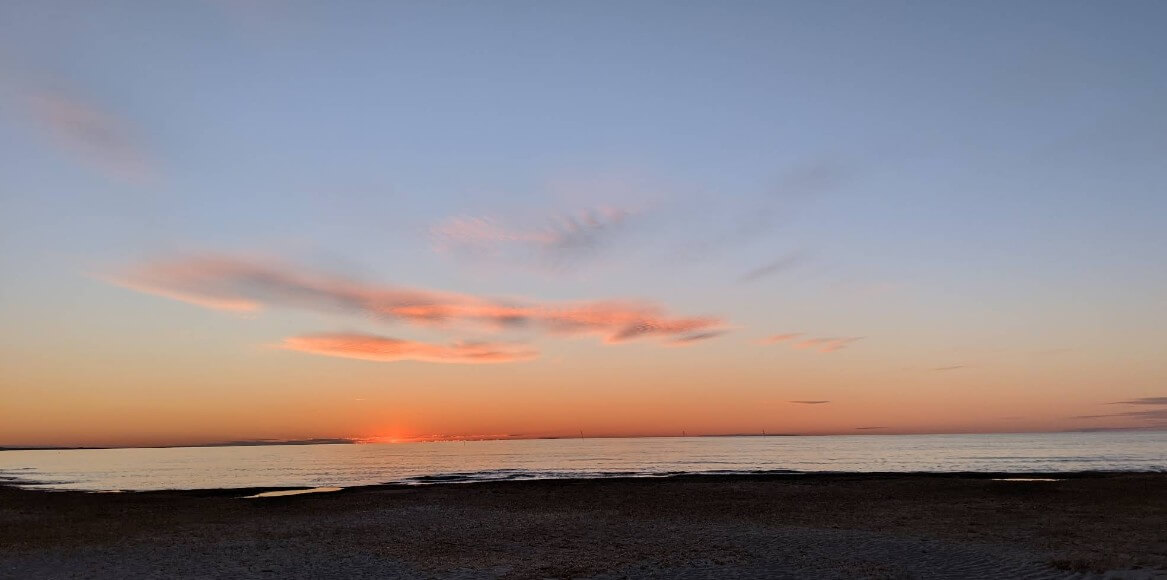
Rock Harbor Beach in Orleans, MA is a small bayside beach on Cape Cod Bay, best known for free parking, tidal flats, a working charter harbor, and west-facing sunsets. Unlike the ocean beaches on the Atlantic side of town, Rock Harbor faces west across open water. The scene here is shaped by tides and boats as much as by sand.
The beach and parking lot are in Orleans, off Bay View Road. Rock Harbor straddles the Orleans-Eastham town line, with each town managing dockage on its own side. When looking for directions, use Bay View Road, Orleans rather than Eastham. That is where the visitor lot and beach access are located.
Rock Harbor Beach Quick Facts
- Address: Bay View Road, Orleans, MA 02653
- Parking: Free, approximately 90 spaces, no sticker or daily fee required
- Lifeguards: None on duty
- Restrooms: Portable facilities available seasonally near the beach
- Best tide for flats walks: Low tide; plan around the tide chart, not the clock
- Tide predictions: NOAA station 8447335 (tidesandcurrents.noaa.gov)
- Sunset direction: West over Cape Cod Bay
- Dogs: Permitted off-season; check posted signs for current seasonal rules
- Official updates: Town of Orleans Rock Harbor page at town.orleans.ma.us
Parking, Access, and Current Harbor Updates
Parking at Rock Harbor Beach is free. No daily fee, beach sticker, or seasonal permit is required at any time. The lot holds approximately 90 vehicles on a first-come, first-served basis.
On clear summer evenings the lot fills before sunset. On weekends in July and August, plan to arrive at least 90 minutes before sundown to secure a space. Shoulder season visits face no such pressure. Spring and fall parking is rarely a problem, even on clear evenings with strong sunset conditions.
Rock Harbor is on the west side of Orleans. From Route 6, take Exit 12 toward Orleans center, then follow West Road and signs to Rock Harbor. The beach is about five minutes from downtown.
The Rock Harbor commercial wharf reconstruction project, which began in late 2024, reached substantial completion by the end of May 2026. The Town of Orleans completed the $9 million rebuild with partial funding from a $1 million Massachusetts Seaport Economic Council grant.
The main visitor parking lot remained open throughout construction. A ribbon cutting ceremony was planned for mid-June 2026. Check the Town of Orleans Rock Harbor Bulkhead Reconstruction page for any remaining punch-list work or access notices before your visit.
How Tides Work at Rock Harbor
Cape Cod Bay has one of the largest tidal ranges on the East Coast, and at Rock Harbor that swing can exceed 10 feet. That difference is the defining feature of this beach.
At low tide, the bay pulls back hundreds of yards from shore. A wide expanse of rippled sand, shallow channels, and tidal flats opens up where water stood hours earlier. The beach grows substantially. At high tide, the same ground is underwater and the beach is small and sheltered.
The harbor channel is only navigable during a specific tidal window. According to the Town of Orleans, Rock Harbor is navigable from 2.5 hours before to 2.5 hours after high tide. That window controls everything here: when charter boats depart and return, when kayakers can reach open water, and when the flats are safely walkable.
Check NOAA tide predictions for Rock Harbor (station 8447335) before every visit. Walking onto the flats at low tide is safe and worthwhile. Walking back as the tide comes in requires planning. Channels refill quickly, and soft mud in some areas slows your pace considerably. Turn around well before the tide turns. The incoming water moves faster than it looks from shore.
Sunsets at Rock Harbor
Rock Harbor faces west across Cape Cod Bay, which means the sun sets directly over open water. On clear evenings the scene includes the harbor's wooden channel markers as silhouettes, the fishing boats swinging on their moorings, and the reflective pools that form across the tidal flats at low tide.
The strongest conditions occur when low tide falls within two hours of the published sunset time. At that stage, wet sand and shallow pools across the flats mirror the colors overhead.
For detailed timing by season, photography positioning tips, and a full comparison of Rock Harbor and Skaket Beach across different tidal conditions, see the best sunset beaches in Orleans guide and the dedicated best times for Rock Harbor sunsets post. Both cover the full lighting windows in depth.
Things to Do at Rock Harbor
Walk the Tidal Flats and Tide Pools
At low tide, the flats extend hundreds of yards from shore over firm sand and shallow channels. Walking them is one of the best free activities on the bay side of Orleans.
As you walk out, look for tide pools forming along channel edges and in low depressions in the sand. These pools hold hermit crabs, periwinkle snails, small fish, and eelgrass. They form within the Inner Cape Cod Bay Area of Critical Environmental Concern (ACEC), a Massachusetts state designation that recognizes the surrounding salt marshes, tidal creeks, and shellfish beds. The flats here are ecologically active, not just scenery.
Turn back earlier than feels necessary. Tidal channels between you and shore fill from their ends rather than evenly across the flat. A tide that looks slow from a distance can move quickly enough to make the walk back wet. Return any creatures you pick up to where you found them.
Watch the Working Harbor
Rock Harbor is a working commercial harbor. The Town of Orleans maintains 43 recreational slips and 12 commercial slips at the harbor, including berths for the charter fleet that targets Cape Cod Bay from May through October. Boats range from small bay fishing skiffs to offshore vessels built for tuna and shark trips.
Charter captains time their departures and returns around the navigable tidal window. On summer mornings, watch boats file out through the marked channel as the water rises. They return in the late afternoon, often just before sunset. Watching the fleet come and go is its own reason to be here, regardless of any interest in fishing.
Young's Fish Market operates at the harbor in season. Downtown Orleans is five minutes away for dining, coffee, and groceries.
Take a Fishing Charter
Rock Harbor has one of the larger charter fishing fleets on Cape Cod Bay. Boats based here target striped bass, bluefish, and bluefin tuna from May through early October. Stripers arrive in the bay by late May. Bluefish move through summer. Bluefin tuna peak in August and September when bait concentrations are highest across the bay.
For seasonal timing, licensing requirements, shore access spots, and regulations for fishing in Orleans, see the Orleans fishing guide.
Kayak or Paddleboard at Rock Harbor
The inner harbor, Rock Harbor Creek, and the channels north toward Little Namskaket Creek make Rock Harbor a practical launch point for paddling. The water is calm in the inner harbor and the marsh channels give a completely different view of the bay than you get from shore.
Launch from the beach or the boat ramp. Stay out of the marked navigation channel when charter boats are moving. Paddle through the inner harbor toward Rock Harbor Creek, keeping clear of the channel markers.
At mid-tide, the channels between Rock Harbor and Skaket Beach open for paddling through the marsh. The route runs roughly 1.5 miles one-way before widening near the broader tidal flat. Plan your return so the rising tide works with you rather than against you.
Beginners should skip Little Namskaket and stick to a short out-and-back along the inner harbor. Tidal currents in the main channel run fast during the two hours around the tide change. Check the Town of Orleans Harbormaster page for current launch rules before putting in. For a broader guide to paddling on the bay side of Orleans, see the kayaking and paddleboarding guide.
Wildlife, Shorebirds, and Marsh Habitat
Rock Harbor and the surrounding shoreline sit within the Inner Cape Cod Bay Area of Critical Environmental Concern (ACEC), a Massachusetts state designation that covers the area's salt marshes, tidal creeks, shellfish beds, and wildlife habitat. This coastline is actively managed and protected.
Great blue herons and snowy egrets work the tidal channels throughout the warmer months. Sandpipers concentrate on the flats during spring and fall migration, when crowds thin and the birds are easier to approach. Look toward the marsh grass north and south of the harbor rather than down the middle of the open flat. Bird activity along the channel edges tends to be more varied and consistent than on the broad sand.
For a full birding guide to Orleans, covering spots on both the bay and ocean sides of town by season, that post covers Rock Harbor alongside the other key locations.
The 1814 Battle of Rock Harbor
A historical marker on Bay View Drive, about 0.1 miles west of the harbor, marks one of the final military actions of the War of 1812 in Massachusetts.
On December 13, 1814, British marines from HMS Newcastle landed at Rock Harbor with orders to recover supplies that had drifted ashore after the Newcastle ran aground on Billingsgate Shoal off Wellfleet. Orleans residents had already claimed or destroyed some of those materials. A local militia led by Captains Higgins and Knowles held a defensive position on the west side of the harbor and forced the British to retreat. One British sailor, Thomas Walker, was killed in the exchange.
The Treaty of Ghent, which formally ended the War of 1812, was signed eleven days later on December 24, 1814. The full story, including Rock Harbor's place in Orleans's broader maritime history, is covered in the history of Orleans MA. The marker at Bay View Drive takes about five minutes to read and is worth a stop.
Rock Harbor vs. Skaket Beach vs. Nauset Beach
Each of Orleans's three main beaches is suited to a different kind of visit.
Rock Harbor suits visitors who want free parking at any hour, tidal flat access, a working harbor to watch, and a west-facing sunset view. It has minimal amenities and no lifeguard. It works better for photography, tide-pool walks, charter boat watching, and quiet evenings than for a full beach day with facilities.
Skaket Beach is the wider bay beach on the northwest side of Orleans. It has a longer tidal flat, restrooms, outdoor rinse stations, and a seasonal snack shack. Parking requires a daily fee or seasonal sticker during the summer season. Families with young children who want a full beach-day setup tend to prefer Skaket.
Nauset Beach faces east across the open Atlantic. It has lifeguards on duty during the summer season, a larger parking lot, changing facilities, and ocean surf. Nauset is the choice for open-water swimming and bodyboarding. It requires a beach sticker or daily fee during the season. The full breakdown of Orleans beach passes, permits, and fees covers the current sticker system for both Nauset and Skaket in detail.
Half-Day Rock Harbor Itinerary
The best version of this itinerary runs on a clear afternoon in late August or September when low tide falls two to three hours before sunset.
Arrive in early-to-mid afternoon. Check the posted tide chart near the parking lot and confirm at least an hour of low or falling tide ahead. Walk out onto the tidal flats toward the channel markers. Forty-five minutes is enough time to reach the markers and return with a comfortable buffer before the tide turns. Watch the channels as you walk back to shore.
Back near the harbor, head north along the beach toward the marsh edge. Look for herons and egrets working the grass at the channel margins. Take a few minutes at the Battle of Orleans marker on Bay View Drive.
If the timing is right, stop at Young's Fish Market before it closes. Then return to the lot, face west, and watch the charter boats come back through the channel. The light builds over about an hour and peaks just before the sun drops below the bay horizon.
The free parking means you can arrive early and stay well past sunset without checking a clock.
The single most useful thing you can do before driving to Rock Harbor is check the tide. A visit timed around low tide in the afternoon gives you the flats walk, the charter fleet's return, and the sunset in one uninterrupted sequence. A visit timed around high tide gives you a smaller beach, a fuller harbor, and cleaner boat silhouettes against the sky. Neither is wrong, but they are genuinely different trips.
Free parking means you can test both without committing to a full-day plan. Arrive, read the scene, stay as long as the light holds.
For current Town of Orleans updates on access, harbor conditions, and seasonal rules, the Town of Orleans Rock Harbor page is the most reliable source before any visit. For visitor information and what else is worth doing while you're in Orleans, contact the Orleans Chamber of Commerce.