
Orleans Historical Society Museum Cape Cod: Complete Visitor Guide
The Orleans Historical Society Museum Cape Cod experience is built around one simple promise. It connects you to Orleans, Massachusetts, through objects, documents, and stories that still shape the town today. The museum operates within the Centers for Culture and History in Orleans, which includes the historic Meetinghouse, Hurd Chapel, and the Gold Medal motor lifeboat CG36500.
This guide follows the museum-focused outline you provided. It covers what to know before you arrive, what you can realistically see in one visit, and how the archives and exhibits tie Orleans’ everyday life to Cape Cod’s longer maritime and civic history.
Why The Orleans Historical Society Museum Matters To Orleans, Massachusetts, Cape Cod
A local historical society museum does more than display artifacts. It preserves the evidence of how a place worked, what people valued, and how communities responded to change. In Orleans, that evidence ranges from family histories and photographs to records that document work, worship, and lifesaving along a dangerous coastline.
The Centers for Culture and History in Orleans describes its purpose in community terms. The Meetinghouse, Hurd Chapel, and CG36500 are framed as “centers” for learning and public life, not as static buildings. That emphasis matters because it explains why you will see exhibits, lectures, and events alongside archival work and preservation projects.
Quick Snapshot: Orleans Historical Society Museum, Orleans, Massachusetts, Cape Cod
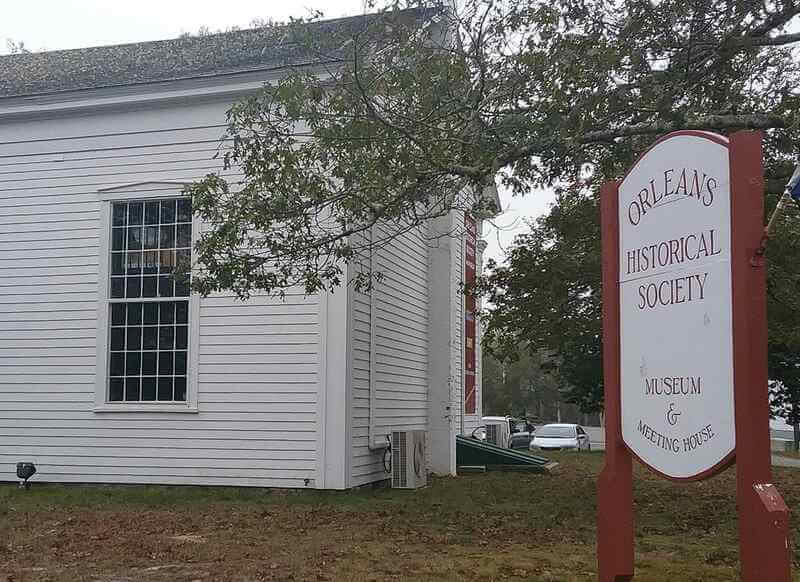
The museum is associated with the Meetinghouse at 3 River Road in Orleans. The organization is also known as the Center for Culture and History in Orleans, and it began in 1958 as the Orleans Historical Society.
The Meetinghouse is a Greek Revival structure built in 1834. The organization states the building is listed on the National Register of Historic Places and has been updated for improved accessibility since 2017.
Orleans Historical Society Museum Address / Directions
If your query is “Orleans Historical Society Museum address/directions,” the essentials are straightforward. The street address is 3 River Rd., Orleans, MA 02653. The phone number is (508) 240-1329.
The museum’s posted directions route most visitors through the Orleans Rotary and onto Main Street, then to River Road. The site also notes that the Meeting House is a large antique structure formerly used as a Universalist Meeting House, which is helpful when you are scanning the streetscape for the right building.
Orleans Historical Society Museum Parking
If your query is “Orleans Historical Society Museum parking,” the museum’s own guidance is the clearest answer. The contact page explicitly states there is parking on both sides of the Museum.
That detail is unusually practical for Cape Cod, where small lots and seasonal congestion are common. It also suggests the site expects routine visitor flow during open hours, not just occasional event traffic.
Orleans Historical Society Museum Current Hours
If you are searching for “Orleans Historical Society Museum current hours,” use the hours shown on the official contact page. It lists current hours through September as Sat/Sun 1–4 pm and by appointment.
That wording matters because it pairs public hours with an appointment path. For planning, it means you can still contact staff for research or special access even when the weekend schedule is the public default.
Is The Orleans Historical Society Museum Open Year-Round?
A clean way to answer “Is the Orleans Historical Society Museum open year-round?” is to separate public hours from access. The posted schedule is seasonal (“through September”) for walk-in weekend visits, but the same page also states “by appointment,” and it adds that research is by appointment and must be made ahead of time by contacting staff.
In practice, that usually indicates that year-round access may exist in some form for research or organized visits, even when public gallery hours are limited. The only reliable confirmation for your exact travel dates is a quick call to (508) 240-1329 because the site’s language is intentionally flexible.
Meetinghouse Museum, Orleans Admission Fee
People often search “Meetinghouse Museum Orleans admission fee” because small local museums vary. The Orleans site does not present a single universal admission price on its main contact page.
What it does show is that pricing can be program-specific. For example, an exhibition listing notes “Admission is $5” for a particular exhibit run.
The site also states that membership benefits include free admission to the Meeting House Museum, which implies that non-member admission may apply at least some of the time. If admission cost is central to your planning, treat it as a “confirm before you go” item rather than assuming free entry year-round.
Orleans Historical Society Museum Accessibility / Wheelchair
The organization states it has invested heavily in updating the Meetinghouse and making it more accessible. The “About” page notes that since 2017, more than $1 million has been raised and spent on updates and accessibility improvements.
Project documentation from a restoration firm describes specific accessibility features added to the Meetinghouse, including a handicap-accessible ramp and lift integrated into the building, along with updated facilities. Use this as supporting context, but still call ahead if you have a specific mobility requirement, because historic buildings can have constraints that vary by entry point and room layout.
How Long Does It Take To Visit Orleans Historical Society Museum?
If your question is “How long does it take to visit the Orleans Historical Society Museum?,” the best answer depends on whether you are doing exhibits only or exhibits plus archives. A focused museum-only visit often fits within an hour because the weekend hours are limited and the museum experience is designed to work within that window.
If you add research, the timeline changes because research is by appointment and involves staff time and handling procedures. That shift turns the visit from a walk-through into a planned session, which can easily take two hours or more depending on the scope of your request.
Orleans Historical Society Museum Guided Tours
Visitors search “Orleans Historical Society Museum guided tours,” but public tour schedules are not presented as a standing weekly feature on the core visitor page. The museum does run programs and lectures, and it actively hosts events, which is often where guided interpretation happens in small historical institutions.
If you want a guided format, your most reliable path is to ask directly when you call. Use the language the museum itself uses, appointments and planned research, because that matches how staff organize time and access.
Orleans Historical Society Museum Group Visits / School Groups
The museum lists “Schools” among its program areas, which signals a structure for education-focused engagement rather than purely casual visits. That matters if you are planning for school groups, because it implies the organization is accustomed to adapting local history content for students.
Group visits still require coordination. The appointment language on the contact page is the operational clue that schools and organized groups should plan ahead rather than assume walk-in capacity during weekend hours.
Orleans Historical Society Museum Contact / Appointments
For “Orleans Historical Society Museum contact/appointments,” the site gives clear instructions. The main email is admin@orleanshs.org, and the phone number is (508) 240-1329.
The same page explicitly says research is by appointment and must be made ahead of time by contacting the staff. If your goal is genealogy, property history, or archival material, treat the appointment step as required, not optional.
Meetinghouse Building, Orleans Greek Revival History
The Meetinghouse is not just the container for the museum. It is a central object in the historical experience. The Centers for Culture and History in Orleans describes it as a Greek Revival structure built in 1834, and it notes its earlier use as the meeting house for the Universalist Church of Orleans.
Greek Revival architecture in New England is often associated with civic identity and 19th-century ideals of public virtue. In a building like this, you can typically expect a strong façade presence and a plan that originally served large gatherings, which helps explain why the space remains well-suited to exhibits and cultural programs.
Universalist Church Of Orleans Meeting House History
The Meetinghouse has an established historic identity in the National Register of Historic Places. The National Park Service’s NRIS asset record for the Universalist Society Meetinghouse at 3 River Rd. shows it was published as a National Register resource on February 25, 1999.
For visitors, the key point is that the building’s Universalist past is not incidental. It explains the site’s original purpose, the style choices, and why the building’s story is part of what you are “reading” when you walk the galleries.
Meetinghouse Museum Orleans National Register Of Historic Places
If you search “Meetinghouse Museum Orleans National Register of Historic Places,” it helps to be precise. The Meetinghouse is listed, and the NPS NRIS asset record is the most authoritative confirmation for that status and the listing date.
National Register listing does not mean federal ownership. It means formal recognition of historic significance and documentation of why the property matters. For a museum visitor, that status often correlates with better-preserved architectural detail and clearer interpretive framing.
Orleans Historical Society Museum Permanent Collection Highlights
The museum’s public descriptions emphasize the depth of its holdings across Orleans’ civic and family life. The Cape Cod Museum Trail describes a collection of more than 6,000 items, including genealogical information, diaries, deeds, 19th- and 20th-century photos, artwork by local artists, ships’ logs, and Native American artifacts.
That range suggests the “highlights” are not a single signature object. The experience is more like a compact survey of Orleans life, where maritime history sits alongside household life, education, work, and the visual record of the town’s changes over time.
Meetinghouse Museum Orleans Rotating Exhibits Schedule
Rotating exhibits are a major reason to check the museum’s exhibition listings before you arrive. The exhibitions page shows that exhibit dates and admission can vary by installation, which is typical for small museums that bring in traveling or themed content.
If you are trying to align your trip with a specific theme, that page is more informative than generic travel listings. It also helps you understand whether your visit is likely to be “permanent collection heavy” or centered on a temporary feature.
Orleans Historical Society Archives Genealogical Records
The museum is not only a gallery space. It also supports researchers and genealogists. One of the organization’s own pages describes an extensive archive, including photos, maps, genealogical information, diaries, deeds, and ship logs, along with special collections focused on Orleans families and individuals.
The operational rule is simple. Research is by appointment, and appointments must be made ahead of time by contacting staff. That requirement protects collections and helps staff locate materials efficiently.
Orleans Historical Society Deeds, Diaries, and Photographs Collection
Deeds, diaries, and photographs are powerful because they anchor abstract history to specific people and places. Deeds trace land use and ownership changes that shape neighborhoods. Diaries reveal how residents experienced storms, work, travel, and local events as they happened. Photographs capture the built environment and daily life details that rarely appear in official records.
When these materials are preserved together, they allow a visitor or researcher to cross-check stories. A family name in a diary can connect to a deed, then to a photograph, then to a map. That is the practical value of a well-kept local archive.
Orleans Historical Society Ships’ Logs Maritime Artifacts
Ships’ logs and maritime artifacts fit naturally in an Orleans museum because the Outer Cape’s economy and risk profile were shaped by the sea. Logs capture weather, route decisions, and incidents that turn into local memory. Artifacts and models make that maritime record visible for visitors who do not read nautical documentation fluently.
The Cape Cod Museum Trail also frames lifesaving as a featured interpretive theme, which aligns closely with Orleans’ association with the CG36500 rescue story.
Orleans Historical Society Native American Artifacts Collection
The museum’s published collection descriptions include Native American artifacts. That inclusion signals a commitment to telling Orleans history as longer than the town’s incorporation and longer than the dominant 19th-century narratives that often shape historic house museums.
For visitors, the key is context. Responsible interpretation depends on provenance, cultural sensitivity, and clear labeling that avoids turning Indigenous material culture into a decorative footnote. The fact that the collection is named in public descriptions creates a baseline expectation that it is presented as part of Orleans’ broader history.
U.S. Coast Guard Vessel CG36500 And The 1952 Rescue / Nor’easter Story
CG36500 is one of the strongest reasons this museum stands out on Cape Cod. The Centers for Culture and History in Orleans states that CG36500 was made famous by a nighttime rescue of 32 crew members from the broken tanker Pendleton during a ferocious winter storm in 1952.
The U.S. Coast Guard has also described the crew’s reputation as the “Gold Medal Crew,” tied to the Gold Lifesaving Medal presentation in May 1952. That framing matters because it reflects how the Coast Guard itself memorializes the event, not just how it appears in popular retellings.
Pendleton Tanker Rescue And Its Lasting Legacy
The Pendleton rescue is often summarized as courage under impossible conditions, but its lasting legacy is also about institutional memory. The boat is preserved and interpreted as a historic object, not merely as a symbol. The museum’s “About the Boat” page states CG36500 as a 36-foot lifeboat built in 1946 and stationed at the Chatham Coast Guard Lifeboat Station, giving visitors an engineering and service context beyond the single famous night.
The same CG36500 materials also describe how the Orleans Historical Society acquired ownership in 1981 and carried out restoration work supported by volunteers. That post-service story is part of the interpretation because it explains why the boat still exists for the public to see.
The Finest Hours Disney Film And How Pop Culture Shapes Local History Interest
The museum explicitly connects CG36500 to The Finest Hours book and Disney movie, which is useful because many visitors arrive with that reference point.
Pop culture can drive attention, but the museum’s value is its ability to ground interest in evidence. A visitor who starts with the film can leave with a better understanding of the boat’s service life, the community’s relationship to maritime risk, and the practical work required to preserve a wooden vessel as a public-facing museum asset.
Hurd Chapel Orleans History
Hurd Chapel is described by the Centers for Culture and History in Orleans as an adjacent resource, and the “About” page provides unusually specific information. It states that the Hurd Chapel was built in 1937, was donated to the organization nearly 40 years later, and is being moved closer to the Meetinghouse with updated systems for year-round use and climate-controlled storage for archives and artifacts.
That description positions Hurd Chapel as more than an event space. It is also a preservation and research asset. Climate-controlled storage is a practical requirement for long-term care of documents, textiles, and photographs, especially in a coastal environment.
Orleans Historical Buildings Tour Meetinghouse Hurd Chapel
If you want an “Orleans historical buildings tour Meetinghouse Hurd Chapel” style experience, the simplest approach is to treat the property as a compact campus. The Meetinghouse carries the early-19th-century religious and architectural story. Hurd Chapel carries the 20th-century expansion story and the archival future.
Because the museum’s directions emphasize landmarks and the building’s appearance, it is also realistic to make the tour partly observational. Even a short exterior walk gives you a sense of how River Road sits within the civic center and how the town’s historic layers coexist.
Lectures, Musical Programs, Community Walks, Programming / Events
The museum’s programming is part of how it stays relevant, and it is also a strong signal of local trust. The organization maintains an events calendar that lists talks and community-style sessions, including presentations led by local historians.
For visitors, programs change the value of a visit. A standard museum stop is mostly visual and self-paced. A lecture or event adds interpretation and community memory, which is often where details that never make it onto exhibit labels become visible.
Planning Your Visit Like A Pro
The most reliable planning method is to build your visit around the posted weekend schedule and the appointment option. The museum’s contact page gives you the structure: Sat/Sun 1–4 pm (through September), plus appointments, plus research by appointment.
Here is a single planning checklist you can use without overcomplicating the trip:
- Confirm “Orleans Historical Society Museum current hours” for your dates, especially outside peak season.
- Save the address: 3 River Rd., Orleans, MA 02653, and plan arrival with time to park on both sides of the Museum.
- Call (508) 240-1329 if you need accessibility specifics, guided interpretation, or research access.
- Check exhibitions and events if you want a themed visit or a program-based experience.
- Treat “Meetinghouse Museum Orleans admission fee” as variable unless the current exhibit listing states a price.
Visitor Etiquette And Archival Best Practices
Small museums protect collections with simple rules. The Orleans museum is explicit that research access is appointment-based, which is usually tied to staff supervision and controlled handling.
If you are visiting as a researcher, arrive with focused questions. Staff time is limited, and targeted requests are easier to serve than broad “tell me about my family” searches. That approach also reduces handling, which is essential for fragile paper, photographs, and textiles.
First-Timer Itinerary Vs. History-Buff Itinerary
A first-timer itinerary works best when it stays exhibit-forward. Use the public hours window, spend time with the core museum displays, and pay attention to the Meetinghouse as a historic object. That approach delivers value even if you do not arrive with a specific research question.
A history-buff itinerary should add one extra layer. Schedule an appointment for research or a focused question about Orleans families, maritime history, or the CG36500 interpretation, and treat the museum visit as the visible surface of a much larger archival system.