

Nauset Beach History: 400 Years of Cape Cod's Most Storied Shore
Nauset Beach carries more history per mile of sand than almost any beach on the Atlantic coast. This ten-mile barrier beach in Orleans, Massachusetts has been shaped by Indigenous peoples, battered by shipwrecks, defended by lighthouses that kept retreating from the cliffs, shelled by a German submarine, and carved by erosion that removes up to twelve feet of shoreline every year.
The story of Nauset Beach is not a single chapter. It runs from the first human settlements on Cape Cod through colonial conflict, maritime disaster, lighthouse engineering, wartime attack, and the present-day fight to keep a beloved beach from disappearing into the sea.
Quick Facts About Nauset Beach History
- Location: Nauset Beach Road, Orleans, MA 02653
- Length: approximately 10 miles, extending south toward Chatham
- Indigenous name: Nauset, from the Algonquian-speaking Nauset people
- First European contact: Samuel de Champlain, 1605
- First Encounter Beach: site of 1620 skirmish between Mayflower crew and Nauset people, just north in Eastham
- Lighthouses: Three Sisters of Nauset (1838); Nauset Light (moved from Chatham, 1923; relocated 1996)
- WWI significance: Only site on the continental United States shelled by enemy fire in World War I (July 21, 1918)
- Management: Town-owned and managed by the Town of Orleans; distinct from the Cape Cod National Seashore
- Erosion rate: up to 12 feet per year in some sections in recent decades
- Current threat: ongoing coastal erosion managed under the Town's Outer Beach Management Plan
Nauset Beach History Timeline
- ~4,000 BC: Archaeological evidence shows human settlement in the Nauset region.
- 1605: Samuel de Champlain maps Cape Cod and makes contact with the Nauset people.
- 1614: English captain Thomas Hunt kidnaps seven Nauset people and sells them into slavery in Spain.
- 1620: The Mayflower crew encounters the Nauset people at what is now First Encounter Beach in Eastham.
- 1626: The Sparrow-Hawk runs aground near Orleans, becoming one of the earliest documented shipwrecks on Cape Cod.
- 1838: Congress funds three lighthouse towers at the Nauset Beach Light Station, leading to the construction of the Three Sisters.
- 1892: Erosion destroys the original brick towers, and three wooden replacement towers are built farther inland.
- 1918: On July 21, German submarine U-156 attacks the Perth Amboy off Nauset Beach, with shells landing on American soil.
- 1923: The North Tower from Chatham is moved to Nauset Beach, where it becomes Nauset Light.
- 1950s: The Town of Orleans purchases Nauset Beach and begins managing it as a public recreation area.
- 1989: The Three Sisters are reunited and restored on Cable Road in Eastham.
- 1996: Nauset Light is moved 336 feet inland to protect it from coastal erosion.
- 2018: A March nor’easter destroys the Nauset Beach snack shack, while scientists document accelerating dune loss.
- 2024: The keeper’s dwelling beside Nauset Light is transferred to the National Park Service and offered as a short-term rental beginning in June 2024.
Why Nauset Beach Is Historically Important
Four threads run through Nauset Beach history and connect the past to the present.
The first is Indigenous stewardship. The Nauset people occupied this coastline for thousands of years before any European ship appeared on the horizon. Their use of the outer beach for fishing and shell fishing and their farming on the heights behind the dunes established patterns of seasonal access that still shape how locals approach the beach today.
The second is maritime danger. The shifting sandbars of the Outer Cape made Nauset Beach one of the most treacherous stretches on the Atlantic seaboard. That danger drove decades of lighthouse construction, redesign, and relocation that produced one of the most complex lighthouse histories in American history.
The third is wartime significance. The 1918 submarine attack made Orleans the only place on the continental United States to receive enemy fire during World War I, a distinction tied directly to the beach and to the transatlantic cable running from Orleans to France.
The fourth is coastal impermanence. Nauset Beach has never stood still. The same erosive forces that toppled three sets of lighthouse towers continue reshaping the beach today, making it a living laboratory for coastal management and a symbol of the broader challenges facing barrier beaches across the Northeast.
The Nauset People: The First Residents
Archaeological evidence places human settlement in the Nauset region as early as 4,000 BC. The Nauset were an Algonquian-speaking coastal people who relied on the rich marine environment of the Outer Cape: fishing, shell fishing, hunting, and growing maize, beans, and squash in fields set back from the beach on higher ground.
- The northern tip of Nauset Beach appears on Samuel de Champlain's 1605 map of Cape Cod, where the area is shown as thickly settled. Those first European contacts were charged with tension. In 1614, English captain Thomas Hunt kidnapped seven Nauset people and sold them into slavery in Spain, an act that shaped how the Nauset viewed outsiders for years.
- By December 1620, when the Mayflower's crew came ashore near present-day Eastham, the Nauset attacked the landing party in a brief confrontation at what is still called First Encounter Beach. No one was killed, but the exchange set the tone for the difficult years ahead. Within two years, disease, war, and displacement had begun to thin the Nauset population dramatically.
- Pre-contact estimates put Nauset numbers at between 1,500 and 1,600 people. A pandemic that swept through New England's Native communities before the Pilgrims arrived may have killed up to 90 percent of the region's Indigenous population. By the time of King Philip's War in 1675, most surviving Nauset had allied with the English settlers against the Wampanoag. The cost of that alliance, combined with disease and intermarriage, reduced official records of distinct Nauset ancestry to just four individuals by 1802.
That record did not mean Nauset ancestry disappeared. Descendants continued through intermarriage with Wampanoag and other Native communities. Their name outlasted every colonial boundary adjustment: Nauset Beach, Nauset Light, the Nauset school district, and dozens of place names across Orleans and Eastham all trace back to the people who first knew this coastline as home.
Shipwrecks and the Danger of the Outer Cape
The waters off Nauset Beach earned a grim reputation almost immediately after European ships began using them. Sandbars shifted without warning, fog arrived fast and thick, and the Atlantic hit the Outer Cape with no natural shelter to blunt its force. The "Outer Bar" off Nauset became the final resting place of scores of vessels.
One of the earliest documented wrecks was the Sparrow-Hawk in 1626, just a few years after the Pilgrims arrived. The ship ran aground near Orleans and its passengers were stranded until rescue arrived. The wreck was buried in sand and largely forgotten until a storm in 1863 re-exposed the hull, giving Cape Cod residents their first look at a seventeenth-century vessel.
By the early nineteenth century, the toll of wrecks had grown serious enough that Eastham residents petitioned Congress through the Boston Marine Society to fund lighthouse construction near Nauset Beach. Their petition succeeded. Congress approved funding in 1836, and construction began on what would become the most complicated lighthouse station in New England.
The Three Sisters of Nauset
Why Three Lighthouses Were Built
Congress approved $10,000 for the construction of three lighthouse towers at Nauset Beach Light Station, completed in 1838. The decision was deliberate. Cape Cod Light in Truro already marked the northern outer Cape with a single beam, and twin lights at Chatham marked the south.
A cluster of three lights at Nauset allowed mariners to pinpoint their exact position by simply counting the beams. It is the only location in the United States where three lighthouse towers were ever built at a single station.
Builder Winslow Lewis constructed three 15-foot brick towers spaced 150 feet apart along the cliff edge. Seen from the sea, they were said to resemble women in white dresses with black hats, which gave them the name that has stuck for nearly two centuries: the Three Sisters of Nauset.
What Happened to the Three Sisters
Erosion began undermining the towers almost immediately. By 1890, the original brick structures had been eaten by the retreating cliff and had fallen into the sea. Three 22-foot wooden towers replaced them in 1892, built 30 feet inland from the original positions. Those wooden towers used the original lenses.
By 1911, the northernmost tower stood just eight feet from the cliff edge. Officials decommissioned two of the three sisters and moved the central tower back. In 1918, the two decommissioned towers were sold at auction for $3.50 to Helen Cummings, who moved them to Cable Road and connected them to a summer cottage.
The National Park Service eventually located all three original wooden sisters. The center tower was acquired in 1975. The other two were found on Cable Road, still functioning as part of a cottage. All three were reunited in their original configuration off Cable Road in Eastham, and restoration was completed by 1989. Free guided tours run through the Cape Cod National Seashore during July and August.
Nauset Light and the Fight Against Erosion
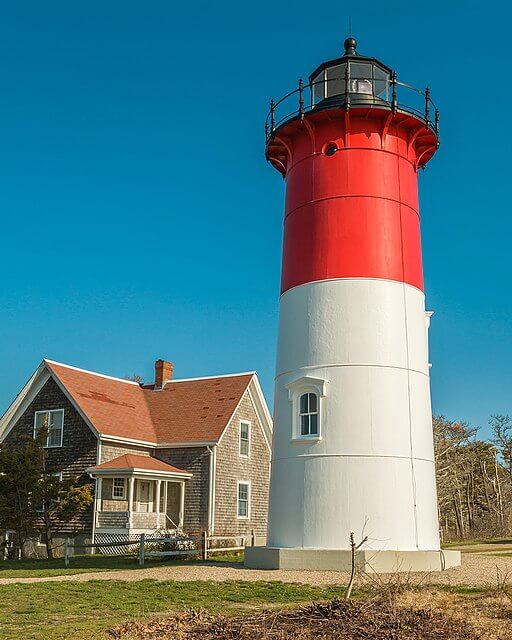
By 1923, the single remaining wooden tower at Nauset had deteriorated beyond repair. The solution came from Chatham, where a decommissioned cast-iron lighthouse, originally built in 1877 and standing 48 feet tall, was dismantled and moved up the Cape to take its place. That tower, reassembled at Nauset Beach, became Nauset Light: the red-and-white beacon that is now one of the most photographed lighthouses on the East Coast and the icon that appears on Cape Cod Potato Chips bags.
Cast iron proved no match for the cliff. By 1996, erosion had retreated the bluff to within 35 feet of the tower's base. On November 16, 1996, the Nauset Light Preservation Society coordinated the move of the 90-ton lighthouse 336 feet inland, a two-day operation carried out by International Chimney Corporation and Expert House Movers.
The move cost $330,000 and took two days. The lighthouse was repainted in 2013 with support from Snyders-Lance, and again in 2021. In April 2024, the keeper's dwelling adjacent to the lighthouse was transferred to the National Park Service, which now offers it as a short-term rental.
Nauset Light remains listed on the National Register of Historic Places. The Nauset Light Preservation Society operates the property on behalf of the Cape Cod National Seashore and estimates the 1996 move bought the lighthouse another 75 to 100 years before erosion threatens it again.
The Battle of Orleans: U-156 and the 1918 Shelling
On the morning of July 21, 1918, German submarine U-156, commanded by Kapitanleutnant Richard Feldt, surfaced approximately three miles off Nauset Beach. The sub had been moving along the outer Cape, and one theory holds it was attempting to locate and sever the transatlantic communications cable that ran from Orleans to Brest, France.
Spotting the 140-foot tugboat Perth Amboy towing four barges along the outer shore, Feldt opened fire with the submarine's deck guns. The first shell overshot the convoy and struck Nauset Beach, sending sand shooting skyward. More than 150 shells followed over the next hour. Three of the four barges were sunk. The Perth Amboy was heavily damaged but stayed afloat. Two crew members were seriously wounded; none were killed.
Lifesavers from Coast Guard Station Number 40 watched the battle from the beach, then rowed directly into the line of fire to rescue the 32 sailors aboard the stricken vessels. Two seaplanes from the recently opened Chatham Naval Air Station arrived and dropped bombs near U-156, but both failed to detonate. Facing aerial pursuit, the submarine submerged and withdrew.
Shells that overshot the Perth Amboy struck Nauset Beach and nearby marshes, making this the only time the continental United States received enemy fire during World War I. Newspapers called it the Battle of Orleans. A historical marker on Nauset Beach still identifies the spot three miles offshore where the attack unfolded.
U-156 continued north, attacking fishing vessels off Maine and Canada before heading back across the Atlantic. The submarine never reached port; it is believed to have struck a mine in the North Sea in late 1918, killing Feldt and his crew.
The transatlantic cable that may have drawn U-156 to Orleans in the first place had its own long history. Laid in 1898, it served as a critical communications link between North America and Europe. The French Cable Station Museum in Orleans preserves that story today.
Nauset Beach vs. Nauset Light Beach: Understanding the Difference
Visitors often arrive on the Outer Cape expecting Nauset Beach and Nauset Light Beach to be the same place. They are not.
- Jurisdiction: Nauset Beach is managed by the Town of Orleans, while Nauset Light Beach is part of the Cape Cod National Seashore and is federally managed.
- Parking fees: At Nauset Beach, visitors need a seasonal town sticker or daily parking pass. At Nauset Light Beach, visitors pay the Cape Cod National Seashore entrance fee.
- OSV permits: Over-sand vehicle access at Nauset Beach requires an Orleans town permit. At Nauset Light Beach, OSV access is handled through the National Park Service permit system.
- Amenities: Nauset Beach offers restrooms, changing rooms, showers, a snack bar, and summer concerts. Nauset Light Beach has restrooms and showers, with Nauset Light located nearby.
- Piping plover closures: At Nauset Beach, closures most commonly affect Nauset Beach South. At Nauset Light Beach, closures are managed by the National Park Service.
- Notable feature: Nauset Beach is known for its 10-mile barrier beach extending toward Chatham. Nauset Light Beach is best known for being adjacent to Nauset Light and the Three Sisters lighthouses.
The two beaches share a continuous stretch of sand, but their fee structures, permit requirements, and management decisions are separate. For anyone planning a visit, checking passes and permits before arriving can make a meaningful difference to your day.
Coastal Erosion at Nauset Beach Today
- Erosion at Nauset Beach is not new. The Three Sisters fell into the sea because of it. Nauset Light was moved because of it. But the rate at which the beach is changing has accelerated sharply in recent decades.
- Before the early 1990s, the beach lost roughly two to three feet per year in most sections. Since then, some areas have been losing up to twelve feet annually. Between 2012 and 2016, Nauset Light Beach lost 45 feet of shoreline. A powerful nor'easter in March 2018 destroyed the snack bar that had served beachgoers for years and caused a major dune recession in a single storm event.
- Geologists now use LiDAR scanning to track change in real time. Their data confirms what lighthouse keepers knew two centuries ago: the cliff cannot be defended against the Atlantic. The goal is management, not prevention.
- The Town of Orleans has responded with its Outer Beach Management Plan, which outlines dune restoration using native plantings and fencing, phased relocation of facilities, and managed retreat. One proposal involves removing approximately 50 feet of the existing parking lot to allow a new protective dune to grow behind it, a project estimated to cost more than $1 million.
Sea level rise, currently estimated at roughly one foot per century in Massachusetts, adds a slow but steady pressure on top of storm-driven erosion. Scientists are clear: this process has been underway since the end of the last Ice Age and will continue. Orleans is building around it, not against it.
Visiting Nauset Beach Today
Nauset Beach draws swimmers, surfers, anglers, and wildlife watchers from across New England. Striped bass and bluefish run along the outer bar. Harbor seals appear regularly in fall and winter, and their presence brings great white sharks into nearshore waters during summer. Lifeguards monitor conditions daily; warning flags go up when shark activity increases.
The beach connects southward for ten miles toward Chatham and northward to Nauset Light Beach in Eastham. Just inland, the Nauset Marsh Trail, accessible from the Salt Pond Visitor Center in Eastham, offers one of the best introductions to the wetland ecology surrounding the beach. For visitors comparing Nauset Beach with the calmer bay side of Orleans, the full guide to Orleans beaches covers Skaket, Rock Harbor, and all other local options.
For those drawn to the deeper layers of the town's past, the history of Orleans, MA, traces the community from its 1797 incorporation through its salt-making, fishing, and maritime economy, all of which ran through the same coastline that defines Nauset Beach today.
Plan Your Visit to Orleans
Nauset Beach did not become one of Cape Cod's most storied shores by accident. It got there through six thousand years of continuous use, through the hard decisions of lighthouse keepers who watched their towers fall into the sea and built again further back, through the courage of Coast Guard surfmen who rowed into enemy fire on a summer Sunday morning in 1918, and through the stubborn commitment of an Orleans community that bought its beach in the 1950s and has been fighting to keep it ever since.
What makes Nauset Beach history worth understanding before you visit is that none of it is abstract. The same erosion that toppled the Three Sisters is actively reshaping the dune line behind the parking lot today. T
The historical marker pointing three miles offshore to where U-156 opened fire is still standing at Nauset Heights. The red-and-white lighthouse that was dragged back from the cliff in 1996 is still flashing, still listed on the National Register, still visible from the water. The past here is not behind glass.
That continuity is what separates Nauset Beach from a beach that simply has a long history. Here, every tide cycle is a reminder that the shoreline has always been a negotiation between the people who depend on it and the ocean that shapes it. The Nauset people understood that. The lighthouse engineers understood it. The Town of Orleans understands it today as it phases back parking lots and plants dune grass along a retreating shore.
If you are visiting for the first time, come for the surf and the seals and the sunrise over the Atlantic. But stay long enough to walk north toward Nauset Light, look at the cliff edge, and understand what it costs to keep that lighthouse standing. The beach you are standing on is still being written.
Browse Orleans beaches to plan your full visit, check passes and permits before you arrive, and reach the Chamber directly at members.orleanscapecod.org/contact with any questions about getting the most out of Orleans.
Explore more about Orleans at orleanscapecod.org.